 AI employees and robots
Humanoid Robots in Warehouses: Prepare for 2027 Now
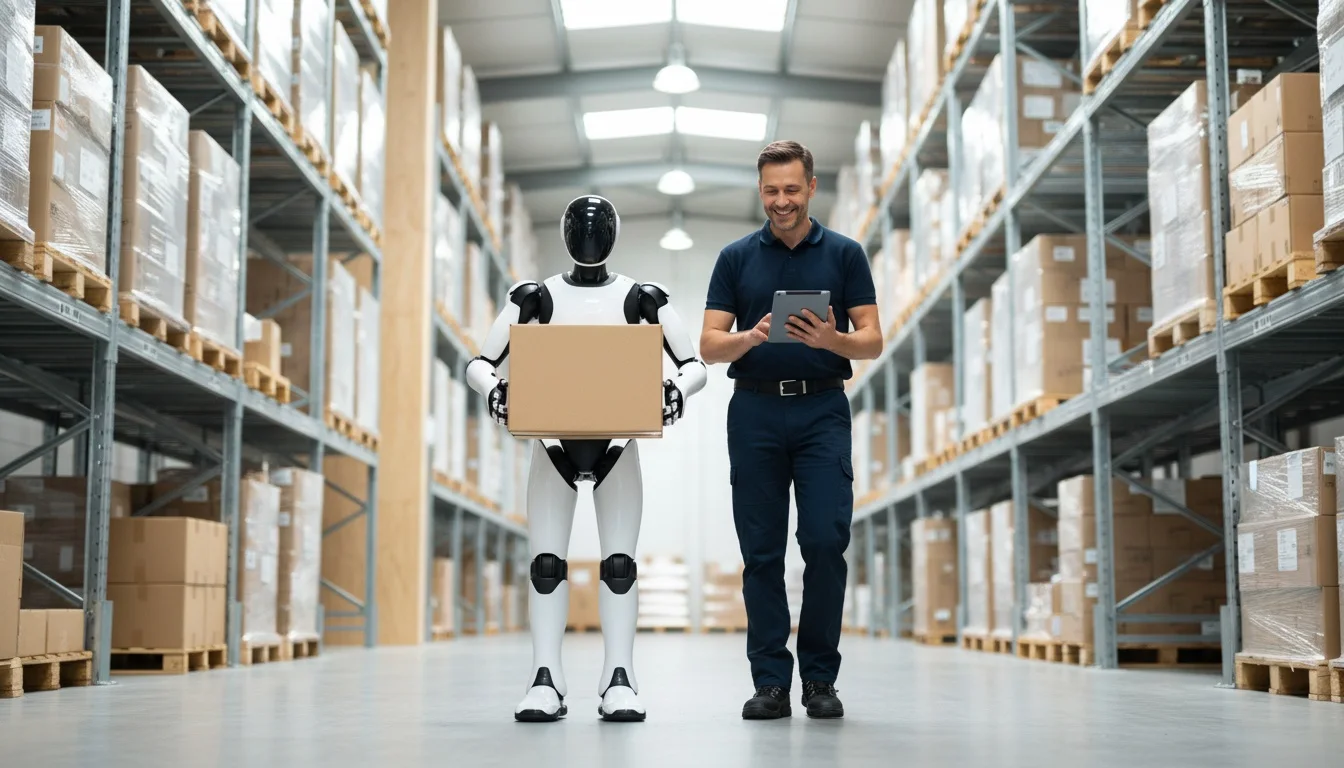
A humanoid warehouse robot is a human-shaped robot that can move and handle objects in a space designed for people, without redesigning the whole site. In logistics, the first realistic uses are moving totes, repetitive handling and supplying workstations. For an SME or a logistics provider, the right question is not "do we need a humanoid?" but "which precise mission, on which site, with what return on investment and what safety?". This guide helps you answer it before ALTEZIA opens orders in January 2027.
Why humanoids are arriving in logistics now
Warehouses are built for humans: aisles, shelving, trolleys, totes, doors, stairs. Classic logistics robots (conveyors, ground mobile robots, fixed arms) are very efficient, but they often require the site to be rebuilt around them.
The humanoid works the other way round: it adapts to the existing site. It picks a tote where an operator would pick it and puts it down where an operator would. Three changes make this possible:
- Perception: cameras and sensors recognize objects and obstacles in real time.
- AI control: robots learn movements from demonstration and simulation instead of being programmed line by line.
- Hardware cost, which is falling and makes first pilots accessible beyond very large groups.
The first stock-market listings of humanoid makers and the deployments announced by large logistics operators show the sector is leaving the demo stage. But we are still talking about pilot sites, not thousands of robots per company.
Realistic warehouse use cases
| Mission | What the robot does | Maturity in 2026-2027 |
|---|---|---|
| Tote transport | Takes totes from a shelf or conveyor and drops them at another station | Pilots and first commercial deployments |
| Repetitive handling | Moves light boxes, feeds a picking area | Pilots on defined sites |
| Workstation supply | Brings parts or consumables to the right station | Industrial pilots |
| Inventory and visual checks | Spots empty locations or labelling errors | Use cases in development |
| Complex order picking | Grabs varied items one by one | Still experimental |
The message is clear: start with a simple, repetitive and well-defined mission. Tasks that require a lot of dexterity or judgment are, for now, better done by your teams.
The ALTEZIA profile for logistics: Alex, logistics operator
In the ALTEZIA AI Workforce Solutions catalogue of hardware AI employees, the logistics profile is called Alex, logistics operator. Its typical mission: tote transport, repetitive handling and internal supply. The catalogue gives these reference points:
- up to 16 hours of work per day;
- an estimated payback of around 14 months;
- a hardware base price from $13,500, excluding taxes, shipping, programming, integration and after-sales service;
- rental or RaaS (robot as a service) on quote.
These are market reference points and indicative estimates, not firm prices. Availability, safety, local support and financing are confirmed case by case, after a site study. ALTEZIA presents a catalogue by mission, not by manufacturer.
A worked example: one tote-transport station
Fictitious data, for illustration only. A warehouse runs two shifts. One operator spends most of the time moving totes between receiving and the picking area.
| Assumption | Value |
|---|---|
| Current yearly cost of the mission (2 shifts) | €90,000 |
| Share of the mission actually handled by the robot | 70% |
| Value of the work handled | €63,000 per year |
| Yearly cost of the deployed solution (amortized hardware, integration, maintenance) | on quote |
The share handled is not an automatic payroll saving. Freed hours are often reassigned to higher-value work: quality control, claims handling, complex picking. The hardware ROI calculator lets you test your own assumptions, for purchase or rental. Our method to calculate the ROI of an AI employee also applies to robots.
Buy, rent or test: the three options
| Option | For whom | Benefits | Watch out for |
|---|---|---|---|
| Pilot | First project, mission to validate | Limited risk, real measurement on your site | Duration and goals set before starting |
| Rental / RaaS | Variable need, cash to preserve | No capital tied up, maintenance often included | Total cost over time, exit conditions |
| Purchase with integration | Stable mission, predictable volume | Controlled cost over the long term | Integration, training and support to plan |
What to check before investing
- The mission: item weight, frequency, distances, shelf height.
- Safety: areas shared with your teams, speed, emergency stops, signage, risk assessment.
- The site: floors, slopes, doors, lighting, wireless network, charging points.
- Integration: connection with your WMS or stock management tools.
- Supervision: who monitors the robot, who steps in if something goes wrong. Our article on human oversight of AI explains this principle.
- Maintenance and local support: response times, spare parts, updates.
- Your teams: explain the project, train people, collect feedback from the floor.
A bare robot, without business integration, creates no value on its own. It is the configured, tested and supervised mission that creates the return on investment.
Questions to ask before signing
Whether you buy, rent or run a pilot, these questions prevent bad surprises:
- What is the maximum load actually handled, and at what pace?
- How many hours does the robot work between charges, and how long does charging take?
- What happens when a person enters its work area?
- Who provides on-site maintenance, and with what response time?
- How does the robot receive its missions: from your WMS, a tablet, an AI employee?
- Which data is collected (images, site maps), where is it stored and who can access it?
- What are the exit conditions if the pilot does not deliver the expected results?
Common mistakes in first projects
- Choosing the robot before the mission: the demo is impressive, but the mission on your own site was never measured.
- Aiming too wide: several different tasks from day one, instead of one simple mission done well.
- Forgetting your teams: a poorly explained project creates distrust and workarounds.
- Underestimating integration: the robot needs to know what to do, when and where, and that goes through your systems.
- Setting no success criteria: without a measurable goal, you cannot decide what comes after the pilot.
The companies that get the most out of their first robot share one habit: they treat the pilot as a measured experiment, not as a showcase. They pick one mission, measure before and after, involve the people on the floor and decide on the next step with real numbers.
Prepare for 2027 in 5 steps
- List candidate stations: repetitive, physically hard or hard-to-hire tasks.
- Measure today's situation: time spent, volumes, errors, accidents, turnover.
- Pick a pilot mission that is simple and measurable.
- Have the site studied: safety, integration, acquisition option.
- Set success criteria before starting: volumes handled, availability, incidents, team satisfaction.
Robots do not replace software AI employees: they complete them. An AI employee can plan tasks, track stock and prepare reports, while the robot executes in the physical world. For the software side, read our guides on the AI employee for small businesses and AI agents for business.
Key takeaways
- A humanoid warehouse robot works in a site built for humans, without redesigning everything.
- Realistic uses today: tote transport, repetitive handling, workstation supply.
- The ALTEZIA profile Alex targets up to 16 hours per day and an estimated payback of around 14 months (indicative reference points).
- Pilot, rental or purchase: the right option depends on mission stability and your cash position.
- Safety, integration and human supervision determine the result.
FAQ
What is a humanoid warehouse robot?
It is a human-shaped robot that can move and handle objects in a warehouse built for people, for example to move totes or supply workstations.
When can I order an AI robot from ALTEZIA?
Orders open in January 2027. Until then, ALTEZIA studies your project: mission, site, safety and acquisition option.
How much does a humanoid robot for logistics cost?
The catalogue shows a hardware base from $13,500 to buy, excluding taxes, shipping, programming, integration and support. Rental and RaaS are on quote. The real cost depends on the mission and the site.
Does the robot replace an employee?
It handles part of a mission. Freed hours are often reassigned to higher-value work. The share handled is not automatically a payroll saving.
Do I need to redesign my warehouse?
Much less than with classic automation, but floors, access, network, charging and areas shared with teams must be checked.
Can I start with a test?
Yes. A pilot on a defined mission measures real results on your site before any wider commitment.
A station to robotize in your warehouse? Meet Alex and have your project studied on altezia.ai.
← All articles